
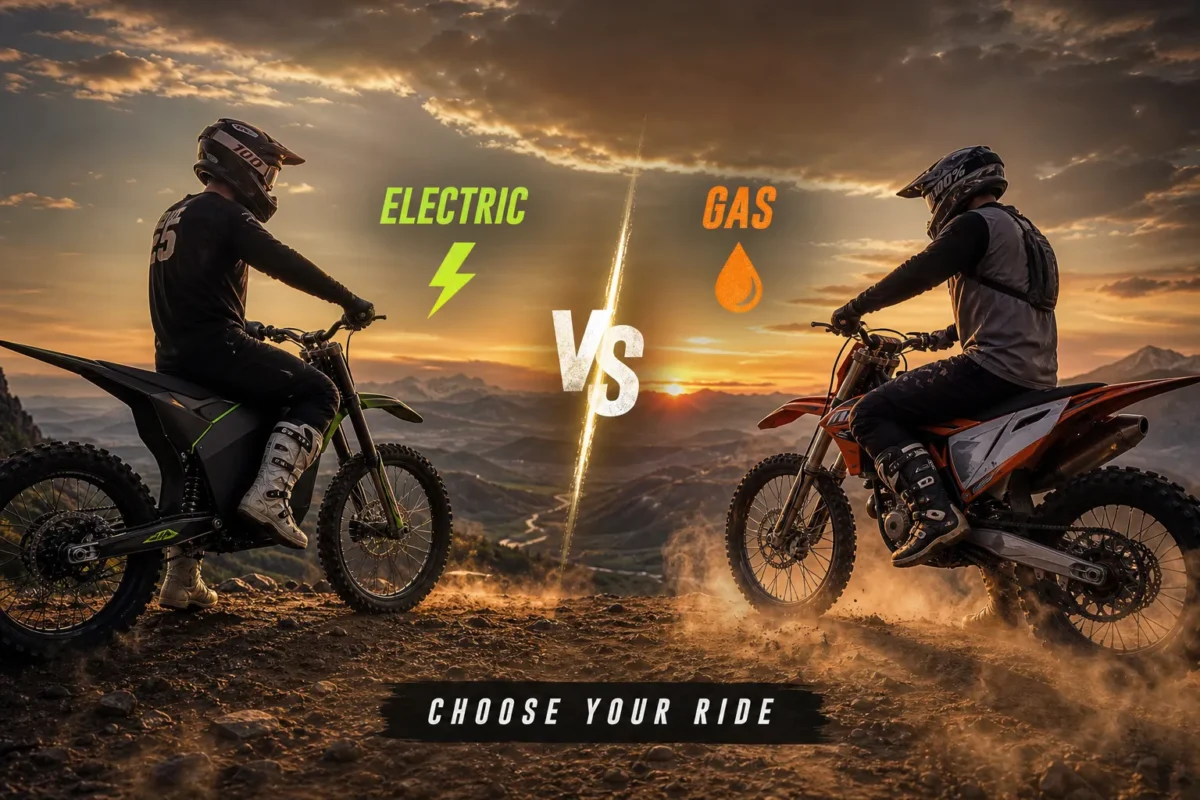
Something has shifted at trail centres and off-road venues across the UK. Riders who would have turned up on a thumping 250cc a few years ago are now rolling in on an electric dirt bike, and the heads turning aren’t just from curiosity. The performance is real, the costs stack up favourably, and the riding experience is genuinely different in ways that matter. But “different” doesn’t automatically mean “better for you.” Whether you’re weighing up a Sur-Ron Light Bee X against a petrol trail bike, or trying to figure out what your kid should be riding, the right answer depends on how and where you actually ride.
This article cuts through the noise on both sides. We’ll compare performance, ownership costs, real-world range, UK legal requirements, and the models worth shortlisting in 2026. At FEPOWERSPORTS, we’ve already stocked up on e-dirt bike models including the Sur-Ron Light Bee because demand has moved well past the early-adopter phase. Treat this as a straight, practical comparison from people who sell both and know what riders actually need.
Performance head-to-head: does electric actually match petrol?
The first thing most riders want to know is whether an electric dirt bike actually feels like a proper machine or a glorified toy. Honestly, it depends on what kind of riding you do, and electric genuinely surprises people who’ve only ever ridden petrol bikes.
Power delivery and torque: a different kind of fast
Electric motors deliver instant, linear torque from the moment you twist the throttle. There’s no power band to chase, no clutch to manage, and no waiting for revs to build. On technical sections where petrol bikes demand precise gear selection and clutch control, an electric off-road motorcycle lets you focus entirely on your line. The Sur-Ron Light Bee X produces 10 kW peak power, hits 50 mph, and weighs just 56.9 kg, genuinely strong for trail riding, and comparable to a 125cc petrol bike in real-world feel, though it’s not a direct match for a 250cc motocrosser at full chat on an open track.
Petrol bikes still hold a real advantage in sustained top-end power for motocross-style riding. When people say an electric bike is “equivalent to 125cc,” what they mean is that the power delivery and pace on trails feel comparable, not that peak horsepower is identical. For most recreational trail riders, that equivalence is more than enough.
Weight, handling, and what changes on technical terrain
Most competitive electric dirt bikes fall in the 55 to 70 kg range, which puts them close to a lightweight petrol 125, though heavier than a modern 2-stroke. The Sur-Ron Light Bee X sits at 56.9 kg; the Talaria Sting R comes in at 66 kg. Where the difference shows up is in weight distribution: the battery pack sits low in the frame, which lowers the centre of gravity and can improve stability through rooted, technical terrain.
Noise is also worth factoring in seriously. Near-silent running isn’t just a novelty. It opens up trail access at venues that restrict loud bikes, makes early-morning riding on private land far less antisocial, and changes the whole character of a woodland session in a way many riders come to prefer.
Real ownership costs: petrol vs electric over three years
The financial case for electric becomes very clear once you look beyond the purchase price. The running cost gap is significant, and it compounds every year you ride.
Maintenance differences: fewer parts, fewer bills
A petrol dirt bike demands regular oil changes, air filter cleans, carburettor tuning or fuel injector servicing, clutch maintenance, and periodic valve clearance checks. An electric dirt bike eliminates nearly all of that. The main wear items are tyres, brake pads, chain, and sprockets, the same regardless of what powers the bike. For a recreational UK trail rider, a 250cc petrol bike typically costs around £300 per year in routine maintenance; an electric equivalent typically comes in around £100 per year.
Battery replacement is the one significant long-term cost to plan for. Most lithium-ion packs deliver 500 to 1,000 charge cycles before dropping to around 70 to 80% of original capacity. For a regular weekend rider, that typically means two to four years before any noticeable degradation. Keep the battery away from extreme heat and avoid storing it fully charged or fully depleted for long periods. Use the correct charger and you’ll stay at the better end of that range.
Electric dirt bike charging costs vs petrol bills
A full charge on a mid-size electric dirt bike costs roughly £0.30 to £0.60 at average UK electricity rates (based on the Ofgem default tariff cap). Filling a petrol dirt bike’s tank costs £8 to £12, and a regular weekend rider on a 250cc petrol bike could easily spend £400 to £600 on fuel annually. Annual electricity costs for the equivalent electric rider typically come in under £50. Factor in savings on oil, filters, spark plugs, and jetting kits, and the running cost gap over three years is substantial, often well over £1,000 in saved expenses.
Electric dirt bike range, charging, and what trail riding actually looks like
Range anxiety is the most common reason riders hesitate before switching to electric. The concern is understandable, but the reality for most UK recreational riding is more manageable than the spec sheets suggest.
The Sur-Ron Light Bee X is rated for up to 46.6 miles, but that figure is based on a controlled test speed of around 25 mph. On mixed UK trail terrain with full power mode engaged, a realistic range is closer to 25 to 35 miles, with hard riding sometimes bringing that down to the low 20s. Plan around 30 miles per charge for mixed terrain and you’ll avoid any nasty surprises. For comparison, a 250cc trail bike with a standard 7 to 8 litre tank covers 80 to 120 miles, a genuine advantage for long enduro days or remote multi-hour routes.
Standard chargers on most electric dirt bikes take 4 to 6 hours for a full charge. Fast-charging infrastructure at UK trail venues doesn’t exist yet in any meaningful way, so overnight charging at home is the practical approach for most riders. For day trips to a trail centre or private land, that works well.
If you’re planning back-to-back riding days, a second battery or an EV-compatible charger at your accommodation is worth factoring into the budget from the start.
UK trail legality: where you can and can’t legally ride
This is where many UK buyers get caught out, so it’s worth understanding the rules clearly before you commit to a purchase.
Road-legal vs off-road: the EAPC rules explained
An electric dirt bike is treated as a motor vehicle in the UK unless it qualifies as an EAPC (electrically assisted pedal cycle). EAPC qualification requires pedals, a motor under 250W, and a top speed limit of 15.5 mph, virtually no electric dirt bike meets that definition. To ride a non-EAPC electric off-road motorcycle on a public road, you need:
- Full DVLA registration
- At minimum, third-party insurance
- The correct driving licence: CBT as a minimum for moped-class machines, and a full motorcycle licence for faster models
- Road-legal equipment including lights, mirrors, and an MOT once the bike reaches the relevant age threshold
Riders under 16 cannot legally ride these machines on public roads, regardless of the bike’s power output.
Road-legalising an off-road electric dirt bike also requires type approval before registration, which most off-road models are not supplied with. Riding an unregistered or uninsured machine on a public road risks seizure, fines, and licence points. The process is possible but not straightforward for most off-road models sold in the UK.
Private land, trail centres, and UK experience days
The good news for recreational riders is that off-road electric dirt bikes can be ridden on private land without registration, insurance, or a licence, provided you have the landowner’s explicit permission and the public does not have unrestricted access to that land. Riding on bridleways, footpaths, or pavements to reach a private riding area is not permitted.
UK trail centres and dedicated venues offer the most accessible legal route for new riders. iMoto X in Glasgow charges £25 for adults and just £1 for riders aged 6 to 16, with a minimum age of 3 for those who can already ride without stabilisers. Begin Off Road runs private family sessions from £46 and children’s beginner sessions from £48, with a minimum age of 4 for one-to-one coaching. Inch Perfect Trials in Lancashire offers free 20-minute test rides on electric trial bikes. For a first session before committing to a purchase, these venues are the practical starting point.
Top electric dirt bike models worth shortlisting in 2026
With the comparisons covered, here’s where the buying decision gets practical. These are the models that make sense for most UK recreational trail riders in 2026, organised by budget and use case.
Sur-Ron Light Bee X: the benchmark mid-range option
The Sur-Ron Light Bee X sits between £3,295 and £4,495 depending on specification and retailer. It produces 10 kW peak power, reaches 50 mph, weighs 56.9 kg, and offers up to 46.6 miles of rated range. It’s the most widely available electric dirt bike in the UK, with the deepest aftermarket ecosystem for parts, accessories, and performance upgrades, something that matters for long-term ownership in a way that’s easy to underestimate at the point of purchase. FEPOWERSPORTS stocks the Sur-Ron Light Bee with competitive pricing and free shipping, so it’s worth checking before committing elsewhere.
Talaria range: strong competition across the budget spectrum
Talaria covers a wider range of price points, from the X3 MX Pro at £3,235 to the Sting Pro MX5 at £3,995, with the broader UK range running from £2,995 to £5,695. The Talaria Sting R produces 8 kW peak and weighs 66 kg, making it slightly heavier than the Sur-Ron but with a more planted, moto-style ride feel and a slightly larger battery capacity. It’s a solid choice for riders who want a more stable platform on longer trail loops or who prioritise aftermarket tuning options. For higher budgets, the Royal Enfield Flying Flea C6 at £5,300 delivers 15.4 kW peak power and a claimed 104 km WMTC range, bridging toward road-legal electric motorcycle territory.
Financing: spreading the cost across UK dealers
Most UK dealers now offer HP or PCP finance with deposits from £500 to £1,000 and terms of 12 to 48 months. APR on standard credit agreements typically sits between 7.9% and 10.9%. Interest free options are available through some retailers for 6 to 24 months, with pay in 3 and pay in 4 plans via Klarna or Clearpay where offered. For a Sur-Ron Light Bee at around £4,000 on a 24-month 0% plan, that works out to roughly £167 per month with no interest cost. For most riders who’d otherwise spend comparable amounts on petrol, maintenance, and parts across a petrol bike’s first two years, the monthly cost difference is smaller than it first appears.
Gas or electric: which one actually suits you?
Rather than a vague summary, here’s a direct steer based on actual riding situations.
Electric is the obvious choice if you ride mostly on private land or at trail centres within reasonable distance of home, where 25 to 35 miles of range is enough for a full session. It also makes clear sense if you want low running costs and minimal maintenance, or if you’re buying for a younger rider. Kids’ electric dirt bikes offer more manageable, linear power delivery, quieter operation for noise sensitive sites, and significantly lower running costs over time.
Petrol still makes more sense if you ride long enduro routes or multi day events where range matters and recharging infrastructure doesn’t exist. A petrol bike’s ability to refuel in minutes remains a major practical advantage for remote riding. Petrol also makes sense if you’re competing in organised events that still classify electric bikes separately, or if your budget is under £2,500 and you’re comfortable buying second hand. The used petrol dirt bike market in the UK is far more mature at the lower end, offering more choice and better value per pound spent.
Making your decision with confidence
Electric dirt bikes are now a genuine, practical alternative to petrol for most recreational trail riders in the UK. The running costs are lower, the maintenance is simpler, and the riding experience on technical terrain is often better than riders expect before their first session. The trade offs on range and charging time are real, but for the vast majority of day sessions at trail centres or on private land, they simply don’t matter enough to be a deal breaker.
If the numbers already add up for you, here’s where to go next: explore the Sur-Ron Light Bee and Talaria range at FEPOWERSPORTS, where free shipping and same week dispatch, backed by manufacturer warranty coverage, make buying online just as straightforward as visiting a dealership. Get in touch with our team if you want to talk through fitment, spec differences, or finance options before you commit.